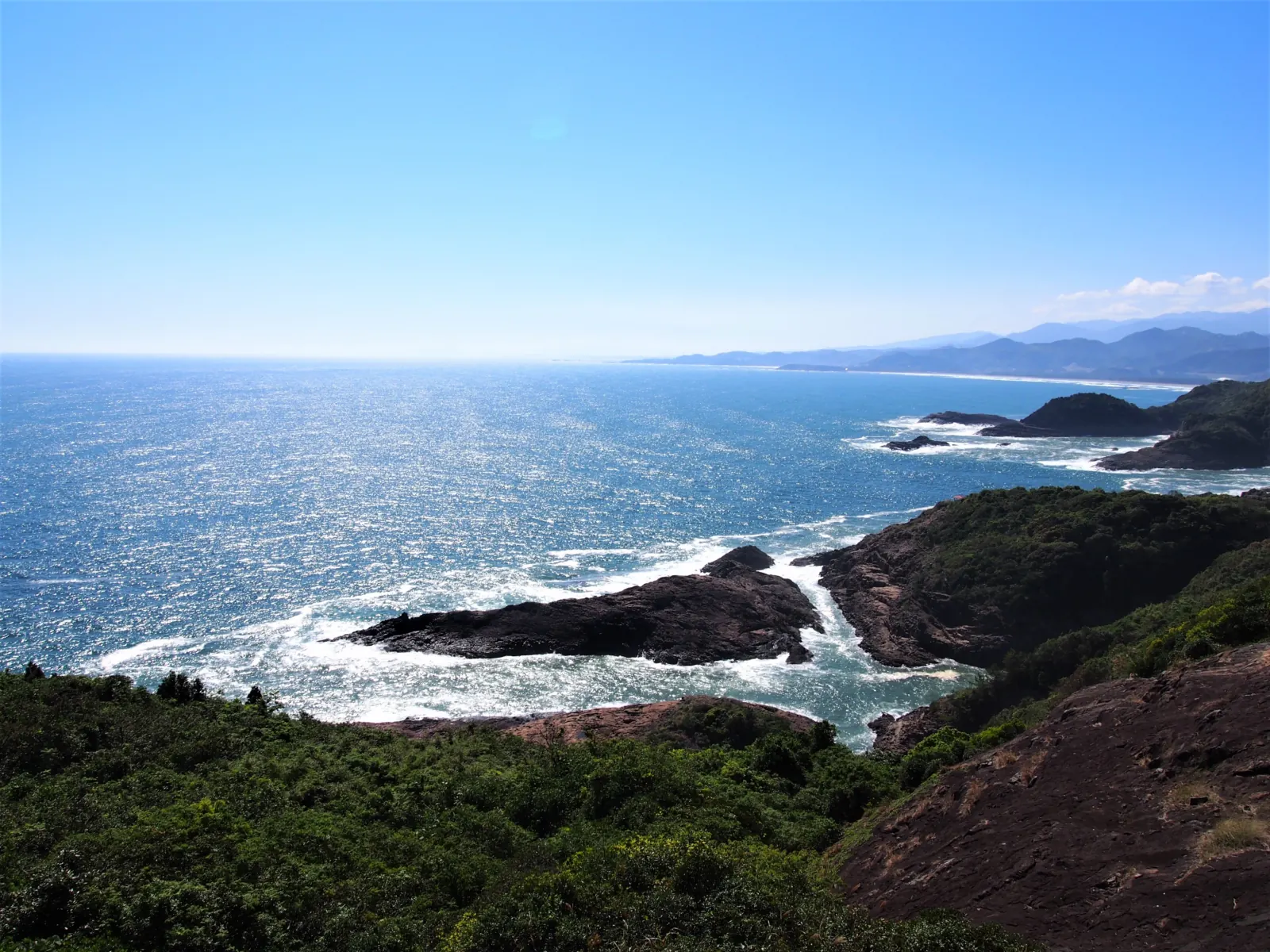
Are you looking for a quiet seaside destination for your next trip? Hyuga City (日向市) is on the coast in the north of Miyazaki Prefecture, between Miyazaki City and Nobeoka. It is best known for its beaches. Okuragahama, which surfers call “OKURA”, runs for about 4 km and has waves all year round; in 2017 it hosted the ISA World Junior Surfing Championship, the first time the event was held in Asia.
Cape Hyuga has the city’s most dramatic scenery. The best-known spot is Kurusu no Umi (クルスの海), the “Sea of the Cross”, where a huge reef is split along two lines, about 200 m east to west and 220 m north to south, so that from the lookout the water between the rocks forms a cross. Kurusu comes from cruz, the Portuguese word for cross. Together with a smaller rock beside it, the shape resembles the character 叶, “to come true”, so it is said that a wish made here will be granted, and there is a bell at the lookout to ring when you make yours.
At the tip of the cape is Umagase, a narrow inlet between sheer cliffs of columnar rock, named because the headland looks like a horse’s back. The columnar jointing of Cape Hyuga is a national Natural Monument. There are two viewing points, one of them a see-through platform that opened in 2022 and juts out over the drop. A footpath leads on to the white Hososhima Lighthouse, first built in red brick in 1910 and rebuilt in its present form in 1941.
For swimming, the city opens two official bathing beaches in summer; Okuragahama, a surf beach, was not one of them in 2026. Isegahama, the main one, is on the Ministry of the Environment’s list of Japan’s 100 best bathing beaches. Mihokogaura lies inside Hososhima bay, where the waves are gentle enough for families with small children; the park across the road allows camping and barbecues, and the calm water suits stand-up paddleboarding (SUP). In 2026 both were open from 18 July to 23 August, 9:30 to 16:30. The tourism association posts each day’s swimming status (in Japanese) during the season.
Next to Isegahama is Omi Shrine, which locals call “Hyuga’s Ise Shrine”. It is known for its sazare-ishi, the kind of pebble conglomerate rock that appears in the words of the Japanese national anthem, and for the “dragon’s jewel”, a rock formation thought to be a trace of ancient dragon-god worship.
Hyugashi Station is worth a look even if you arrive by car. The present building, designed by the architect Hiroshi Naito, opened in 2006 and makes generous use of Miyazaki cedar from the Mimi River basin; visitors praise its scent of wood. In 2008 it won the top prize at the Brunel Awards, an international railway design competition, the first Japanese station building to do so.
In the south of the city is Mimitsu, once the port of the Takanabe domain. Its Tatenui district is a nationally designated preservation district for groups of traditional buildings, and its streets still look much as they did from the late Edo period to the Meiji era, when shipping agents’ houses lined them. According to legend, this is also where the future Emperor Jimmu set sail for the east.
The Hyuga City Tourism Association (in Japanese) has current information on sights, beaches and events; check it before you travel.